
In their opening remarks Ms. Gloria Bozyigit from the Permanent Mission of Austria in New York emphasized the importance of better understanding, within a UN framework, the humanitarian consequences of nuclear weapons on a scientific basis. The Vice Governor of Nagasaki Prefecture, Ms. Yuko Baba, and the Governor of Hiroshima Prefecture, Ms. Mika Yokota, underlined that they hope that the experiences of the inhabitants of both Japanese cities in 1945 will never been repeated again and that their fate is an impetus for further nuclear disarmament. Mr. Takashi Nakamoto, Chairperson of Hiroshima Prefectural Assembly, stressed the fact that the ongoing NPT review Conference will pick-up the need of many countries to continue nuclear reductions.
The side event was chaired by Prof. em. Dr. Götz Neuneck, Chair of Pugwash Council. As a physicist he pointed to the fact the physicists invented the principles and mechanisms to make nuclear weapons work and have also studied their effects for a long time. A nuclear explosion is not like a normal conventional weapon with high yield, but has three effects: Thermal radiation from the nuclear fire ball explosion, a blast wave with much destructive energy, and nuclear radiation with deadly short-term and long-term effects by ionizing radiation. Much interdisciplinary research has been invested in the last 50 years. Now it is time to understand better the effects in a 21st century environment by studying and modelling climate, human and economic consequences, cascading effects for supply chains, food security or the environment.
The purpose of the Panel was to receive reports from participants of the UN Scientific Panel on the Effects of Nuclear War which was mandated in December 2024 by a UN resolution. The following panel included two members of the UN Scientific Panel on the Effects of Nuclear War.
The chair of the UN Independent Scientific Panel on Effects of Nuclear War, Prof. Dr. Ana Maria Cetto Kramis, described the main task of the panel which will release the fourth UN study next year. She emphasized that the scientific advances of physics and modelling, atmospheric chemistry and health sciences has become much deeper over the years. She underlined that scientific findings “can shed light on the connection between nuclear risks and global sustainability” and help “to identify practical steps for reducing risk of nuclear war.” Scientists also can also develop new technologies to verify arms reductions and the absence of nuclear weapons.
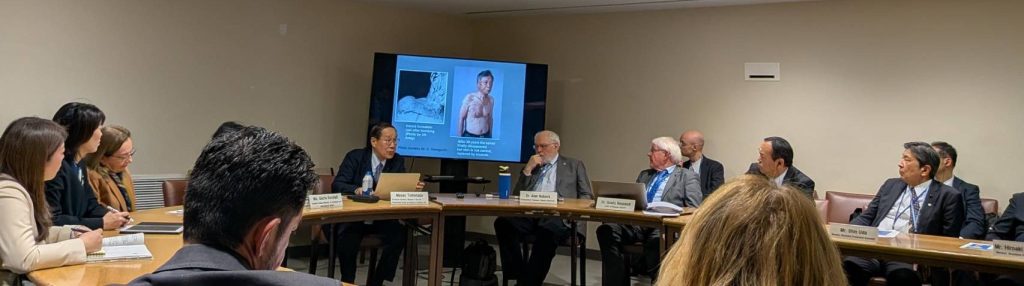
Prof. em. Masao Tomonaga, an atomic bomb survivor, Emeritus Director of the Japanese Red Cross Nagasaki Atomic Bomb Hospital and a member of the UN Independent Scientific Panel on Effects of Nuclear War, presented the analysis of different medical studies about the ionizing effects of nuclear radiation on the victims of the atomic bombings including radiation exposure, cancers, depression, and post-traumatic stress disorder. These are important results and data basis of real damages on the human body and the natural environments.
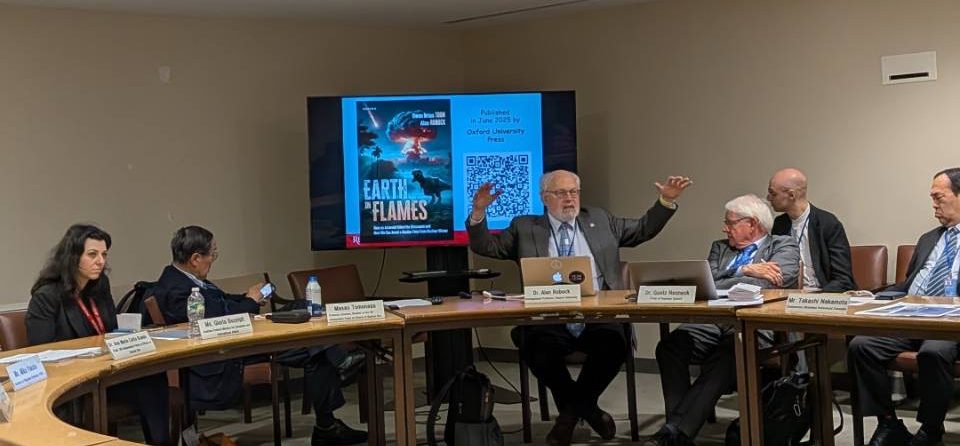
Prof. Alan Robock, a distinguished Professor of climate science in the Department of Environmental Sciences at Rutgers University and 2022 winner of the Future of Life Award, “For reducing the risk of nuclear war by developing and popularizing the science of nuclear winter. His research and modelling results showed that in a nuclear war, massive fires produced by attacks on cities and industrial areas would generate smoke that would blow around the world, persist for years, and block out sunlight, producing a nuclear winter. Because temperatures would plunge below freezing, crops would die and massive starvation could kill most of humanity. Even a regional nuclear war (for example between India and Pakistan) could produce climate change unprecedented in recorded human history and massive disruptions to the world’s food supply.
A short questions and answers section rounded-up the event. Two other Pugwash Council members Cesar Jamarillo and Annick Suzor-Wiener were present too.
Photographs courtesy of the Japan Campaign for Abolition of Nuclear Weapons