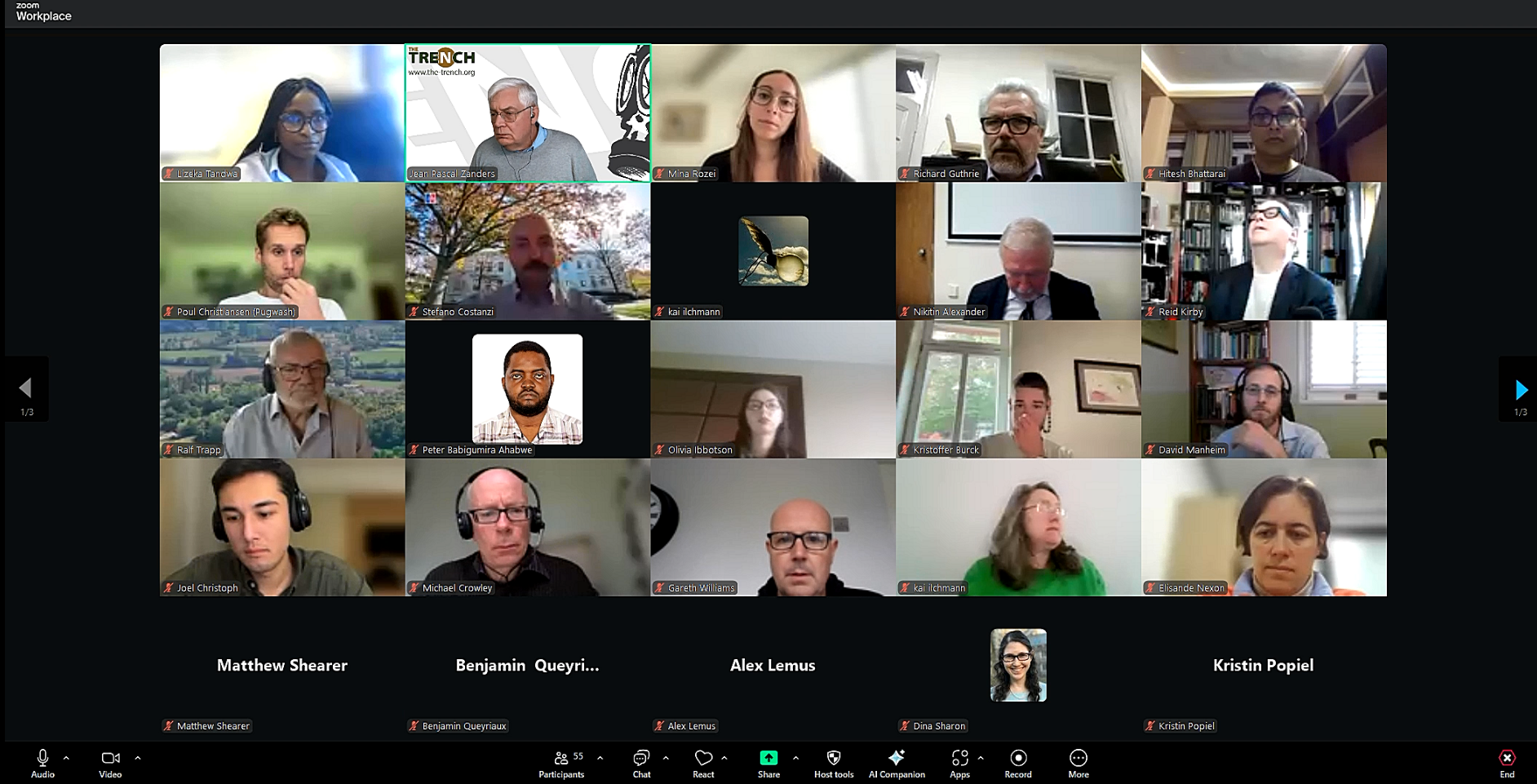
On 3 October 2025, the Pugwash Chemical and Biological Weapons Working Group (CBW WG) held its first event, drawing more than 75 persons from all continents, including the Middle East and North Africa, to a virtual meeting. The primary objective was to gather feedback on potential topics for the WG’s development, thereby gaining a deeper understanding of the WG’s specific role in the current academic and civil society landscape. Registrants completed a small questionnaire covering both topics.
Summary
Jean Pascal Zanders and Lizeka Tandwa opened the meeting. Götz Neuneck, Chairperson of the Council, introduced Pugwash, its history, current activities and working methodologies. Richard Guthrie (Pugwash UK) and Mina Rozei (Chemical Weapons Convention Coalition) presented the current challenges for the Biological and Toxin Weapons Convention (BTWC) and the Chemical Weapons Convention (CWC), respectively. They concluded by suggesting substantive areas of work for the CBW WG, most prominent among them being treaty verification, scientific and technological cooperation for peaceful purposes and the impact of science and technology on the future of the BTWC and CWC. Lizeka Tandwa closed the meeting, highlighting the CBW WG’s explicit goals and inviting attendants to engage with the CBW WG.
On the goals of Pugwash and its CBW WG
Zanders noted that following decisions by the Pugwash Council last year, the CBW WG has been reconstituted. The WG has its origins in the biological weapons (BW) working group set up in the 1960s after Pugwash had dedicated much of its Fifth International Conference in August 1959 to the rising threat of biological warfare. This working group evolved into the Chemical and Biological Warfare Project of the Stockholm International Peace Research Institute (SIPRI). In 1992, the Pugwash CBW Working Group resumed its activities as the CWC negotiations came to a close and the BTWC state parties began to consider possible verification measures after the Third Review Conference in 1991. Activities ended over a decade ago. New challenges to both the BTWC and the CWC, and the need for both conventions to adjust to the new security challenges, led to the decision to re-initiate the CBW WG.
Tandwa outlined the aims of the first virtual meeting. The CBW WG wishes to engage with the global CBW community collectively. Collecting ideas around particular topics that presently occupy the international community will enable Pugwash to fulfil its specific role and be responsive to the needs identified by technocrats, policymakers and the various stakeholder communities. Pugwash aims to facilitate dialogue and discussions across divides. The CBW WG aims to introduce itself as a platform for supporting and developing CBW spaces, exploring how participants may engage with and contribute to these spaces.
Chairperson of the Pugwash Council, Götz Neuneck, noted that the prevention of armament with non-conventional weapons is at the heart of Pugwash’s mission. CBW belong to its core. He described Pugwash as a network of scholars, scientists and experts. It is not a powerful non-governmental organisation (NGO) with considerable financial and personnel resources. Its strength, however, lies in the trust among peers and its ability to communicate with peers across divides. He welcomed the many young faces and the participants from the Global South to the virtual meeting. For a large part of its history, the East-West confrontation determined the Pugwash priorities. The challenges today are different, and he expressed the hope that Africa, Asia, and Latin America will continue to join in future debates. He also referred to International Student/Young Pugwash (ISYP), a separate organisation for people under 35 whose objectives align with those of Pugwash.
Neuneck elaborated on the roles of the various Pugwash Working Groups. They provide a platform for participants to raise issues, express controversial positions, or introduce innovative ideas. Central themes in all gatherings are the promotion of the responsible application of new technologies and the study of the implications of new technologies to understand their potentially destabilising characteristics. In sum, a Pugwash meeting comprises trustful and confidential dialogues across divides. Today, its approach is needed more than ever to avert conflict escalation and global instability.
Challenges to the BTWC and CWC and questions for the CBW WG
Richard Guthrie (CBW Events and British Pugwash) made the first thematic presentation on BW control and the work of the Pugwash Conferences. He identified six issue areas that need to be addressed to strengthen the regime against BW:
- Definition of defensive as opposed to offensive work on BW;
- Utilisation of existing international channels for guarding against military applications of newly acquired microbiological knowledge;
- Problem of allegations of a BW attack;
- Composition of inspection teams, terms of reference and method of work;
- Equipment required by inspection teams and technical processes for BW detection; and
- Usefulness of partial and complete declassification as a means of control.
He also expanded on the history of the CBW working groups and the Pugwash methodology. As three priority areas for consideration by the current Pugwash CBW WG, he proposed:
- Methodologies for investigation of alleged use of BW;
- Oversight of scientific and technological developments relevant to the control of BW; and
- Promotion of peaceful uses of science and technology (S&T).
The second presentation by Mina Rozei (CWC Coalition) addressed possible contributions by the CBW WG to the CWC. She identified three current paradigms, namely, preventing the re-emergence of chemical weapons (CW), promoting the peaceful uses of chemistry and addressing past CW events. She outlined several options for work by the CBW WG.
Prevention of the re-emergence of CW covers many aspects of treaty operation and implementation. The challenges relate to how the verification regime can remain relevant in view of advances in S&T, the emergence of new actor categories (e.g. terrorists), and maintaining the relevancy of the CWC for future generations.
Promoting the peaceful uses of chemistry requires action and engagement in the prevention of the misuse of chemistry, awareness of S&T advances and their relevance for the convention, and the effective dissemination of knowledge while preserving the strength of the norm.
Chemical weapons and their use have left a legacy that has only been partially addressed. These include the risks to humans and the environment posed by old CW (unexploded munitions on former battlefields or former storage sites), CW abandoned by a state on the territory of another state party, or sea-dumped munitions. The use of CW in recent armed conflicts poses challenges of long-term medical assistance and international aid. Research into the physiological consequences of exposure to toxic agents and the long-term health consequences is also needed. Past use also raises questions of attribution and justice.
Main discussion points
On the BTWC and the CWC
- On the relationship between the BTWC and the WHO: any large-scale BW attack would be a health emergency, in which the WHO, but not the BTWC, would play a role. However, any WHO involvement beyond health care following a deliberate disease outbreak would jeopardise its primary mission and expose its health care workers to accusations of partisanship. Determining the origin of an outbreak or attribution requires different tools. Still, with these considerations in mind, no gap between the WHO and BTWC should be allowed to appear.
- According to several participants, a priority topic for the CBW WG should be verification of the BTWC in particular.
- It was noted that President Trump proposed BTWC verification during his address to the UN General Assembly and that Russian officials reciprocated the interest. The suggestion might advance the creation of an open-ended working group to outline verification machinery at the Tenth BTWC Review Conference in 2027. While acknowledging a momentum for resuming verification discussions in the current BTWC Working Group, several participants expressed concern about the lack of substance in President Trump’s statement.
- President Trump’s idea also included the use of Artificial Intelligence (AI) in support of the verification process. While there may be some uses for AI, the US suggestion requires clarification. Given the nature of the biotechnology industry and life sciences research, how can AI effectively detect anomalies? At the same time, AI must also be assessed in relation to the development of new agents, its application to confidence-building measures (CBMs), and the evaluation of the changing nature and geography of research activities.
- According to several participants, a priority topic for the CBW WG should be verification of the BTWC in particular.
Issues for consideration by the CBW WG
- Several participants noted that, in the current threat environment, the use of BW or CW does not necessarily signify large-scale battlefield attacks by soldiers. Hybrid strategies may involve biological or chemical agents in many different ways, and it is possible that instead of the military, economies or health care may become the primary targets.
- These considerations led to the question of what the meaning of a biological or chemical weapon is in the current security/threat context. For both conventions, what does the goal of preventing the (re-)emergence of BW or CW actually mean today, given the repeated use and allegations of use of toxic agents and toxins over the past few years?
- Attention was drawn to the reality that there are other malign uses of toxic substances or pathogens away from the battlefield, notably to incapacitate or punish individuals or groups as part of law enforcement. Particularly concerning C/B agents that act on the central nervous system (the so-called incapacitants) or other organs, questions need to be raised about the types of sciences and technologies involved and the gaps that may exist between the various control regimes.
- Given that the BTWC and CWC are treaties negotiated during the Cold War, they contain implicit assumptions about the context in which C/B agents might be used, namely as a method of warfare in large-scale wars. In today’s security context, terms such as war or armed conflict require clarification, particularly since the agents might be applied along a continuum from personal defence to major war. Hybrid threat scenarios complicate the context of use even further. Neither the BTWC nor the CWC define the concepts and, consequently, there may be uncertainties as to when state parties should or can act under the respective treaty terms.
- In a similar vein, participants also discussed emerging weapon technologies. In particular, they noted that:
- In the efforts to strengthen the BTWC and CWC, following the latest hypes in S&T and associated threat projections should be avoided. Instead, analysis of S&T developments as a whole should focus on how they (do not) undermine the governance assumptions and the measures needed to reinforce the governance system.
- Due consideration should be given to ‘older’ weapon technologies. They can still find utility in different contexts (e.g. assassinations, hybrid operations, sabotage, terrorism, or limited conflicts).
- An important angle is to investigate how the prohibitory regimes may reshape how actors perceive the feasibility, value, intent, or utility of CBW. Shifts of those perceptions in unexpected ways may destabilise the assumptions underpinning the functioning of the conventions (including verification and investigation).
- The issues raised under the previous bullet points require careful prior consideration when setting out options for future verification, especially for the BTWC and CWC. Some additional points raised were:
- Identification of practical verification measures that can actually be implemented. What are, intellectually and scientifically, the most appropriate analyses of the challenges to the BTWC and CWC from a verification perspective?
- There must be a realisation that verification requirements and processes today would be quite different from the ones considered twenty-five years ago. A thorough understanding of today’s challenges is needed.
- Foresighting techniques will be necessary to anticipate potential threat landscapes over the next five to ten years and beyond.
- Proposed verification measures should be trialled under realistic circumstances. There could be voluntary verification exercises on a national or minilateral level. Such exercises, with a focus on ‘how-to’, are also needed to overcome the most common objections to verification.
- Identification of practical verification measures that can actually be implemented. What are, intellectually and scientifically, the most appropriate analyses of the challenges to the BTWC and CWC from a verification perspective?
Concluding the virtual meeting
The proposals and suggestions will be considered during the 63rd Pugwash International Conference in Hiroshima on 1-5 November. Decisions will be taken on the themes, structure of the activities, and fundraising.
The general work plan foresees regular virtual meetings, some of which will be open to all interested persons, others will address specific questions on expert levels, and there will also be meetings specifically for the younger researchers, academics and scientists who wish to deepen their understanding of the challenges posed by CBW.
In closing, Lizeka Tandwa invited all attendants to participate in future CBW WG activities based on inclusiveness, trans-generational dialogue and equitable geographic engagement.
 Pugwash Conferences on Science and World Affairs