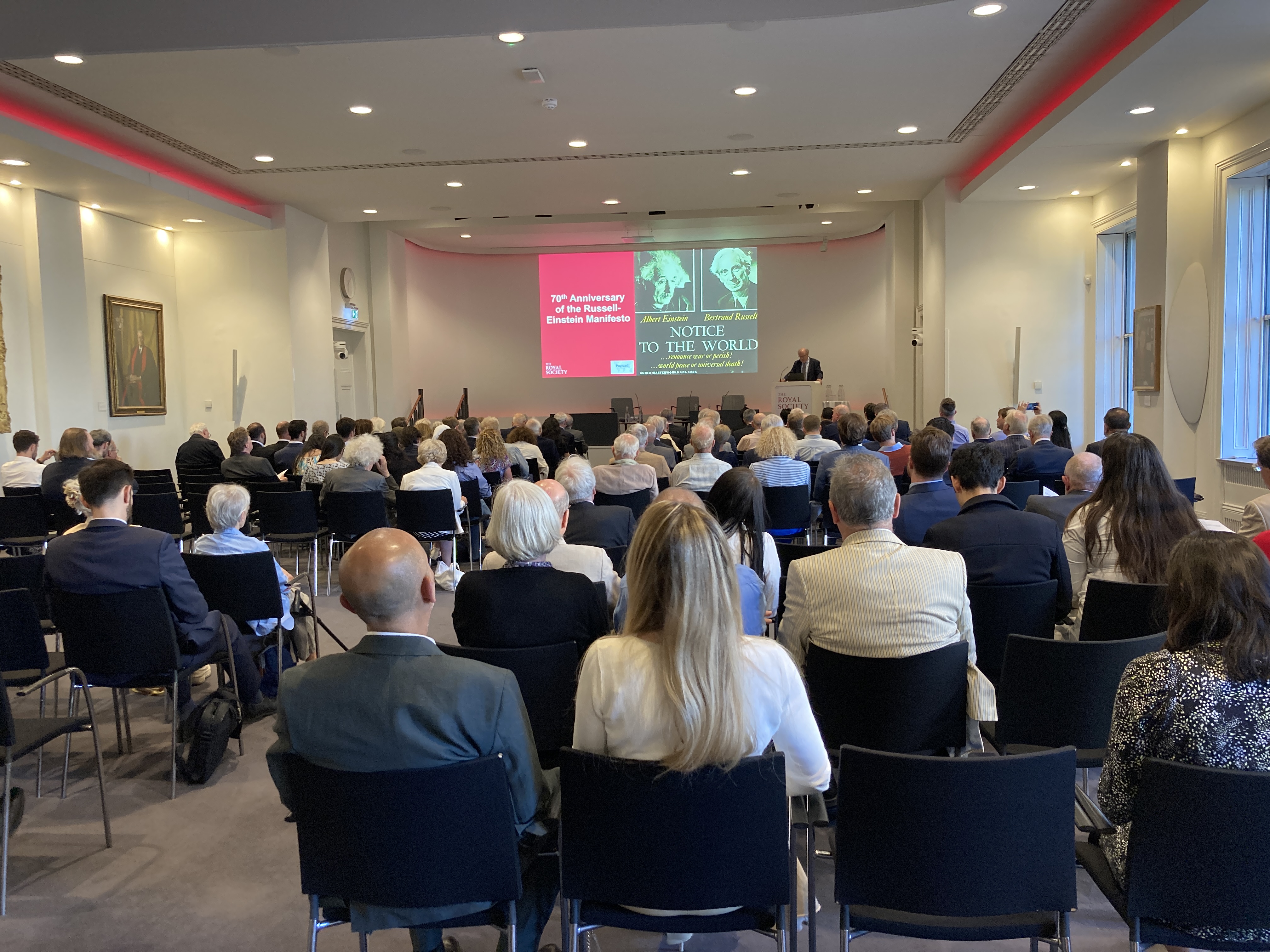
On 8 July 2025 the Pugwash Conferences on Science and World Affairs hosted an event together with the Royal Society to mark the 70th anniversary of a declaration signed by Albert Einstein, Bertrand Russell, and nine other prominent scientists from across the world.
On 9 July 1955, the Russell-Einstein Manifesto was launched in London. This document, which is the foundation of the Pugwash movement, warned of the perils that had arisen as a result of the development of nuclear weapons. Seventy years later, at this critical time in world politics, 150 scientists, politicians and members of the public met again in assembly to reflect on the risks posed by nuclear weapons, their effect on global peace and security, and the Manifesto’s call on scientists to concern themselves with the perils of the nuclear age.
In opening remarks delivered on behalf of the President of the Royal Society, the audience were warned that, much like the situation which faced Russell, Einstein, Rotblat and the other signatories to the Manifesto, the present world seems to be a time of great peril. There followed a reading of the Russell-Einstein Manifesto delivered by Talia Weiss, director of the International Student Young Pugwash.
Pugwash President Dr. Hussain Al-Shahristani recalled that the Manifesto led directly to the first Pugwash Conference in 1957, to which Bertrand Russell – unable to participate in person due to ill health – submitted his conviction that that reducing mutual suspicion even amongst the group of scientists “will prove the seed from which gradually, a sense of common human problems will come to replace the present futile competition.” Dr. Al-Shahristani reminded those present that “we in the Pugwash movement remain steadfast in our belief that nuclear weapons threaten the continued existence of mankind and that nuclear disarmament is a necessary condition toward reducing the reliance on war.”
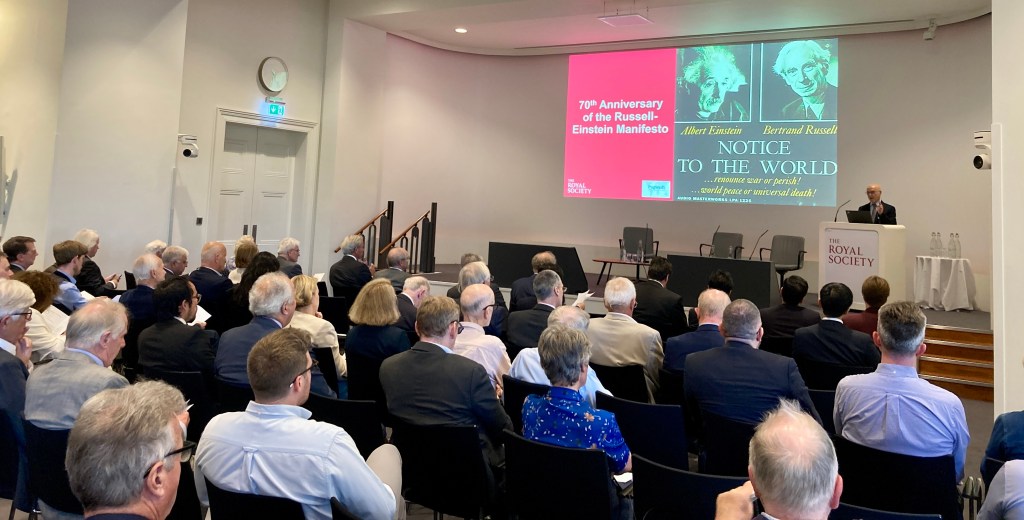
In his speech, Lord Browne of Ladyton remarked that he was struck by the immediacy of the message of the Manifesto, given the splintering consensus and fracturing geopolitics of our current era. He underlined that it was scientists from both sides of the Iron Curtain who laid the foundations for what was achieved in nuclear arms control, providing the means to ‘trust but verify’. Through reminding us that the seeds of the post-cold war optimism were planted by the pioneering work during Pugwash Conferences in the darkest days, Lord Browne encouraged persistence to meet the challenges ahead.
There followed a moderated discussion on how to address those challenges and revive momentum toward nuclear arms control and risk reduction. Across the discussion between Dr. Marion Messmer, Prof. Steve Fetter, Dr. Tong Zhao, and Dr. Andrey Baklitskiy, several key points emerged with clear echoes to the time of the Manifesto. First, great power rivalry is driving a greater reliance on nuclear weapons than in recent decades. Second, the current direction of travel among the major powers will produce an arms race and potentially a greater number of nuclear weapons states. Third, returning to arms control is hampered by mutual suspicion, enemy images, and a prioritizing of ‘peace through strength’ rather than valuing dialogue and diplomacy. And fourth, that developments in technology present novel challenges for which dialogue among states will be not just critical but essential. By way of remedy, it was suggested that greater focus was required – especially by the nuclear weapons states – on basic principles of international relations and norms of behaviour. It was also underlined that, while the greatest responsibility lies with those nuclear weapons states, the entire international community has a voice to compel adherence to commitments and international law.
The final session synthesized a number of overarching themes of the commemoration event. First, that public awareness of the threat which nuclear weapons pose has dissipated since the cold war. Second, scientists are uniquely placed to perceive the critical developments in science and technology which are impacting – and often exacerbating – geopolitical tensions. Third, that scientists have an important role in engaging and shaping the public debate in each country, in particular stressing that nuclear weapons use by any country in any region will have global consequences. Indeed, as Pugwash Secretary General Prof. Karen Hallberg noted in her address, “The Manifesto reminded us that our responsibility as scientists does not end with research and discovery. It begins there. When Bertrand Russell and Albert Einstein issued their call, they asked us not just to think deeply, but to think differently. Not simply as scientists, but as members of humanity, entrusted with knowledge that could either preserve or extinguish life on this planet.“
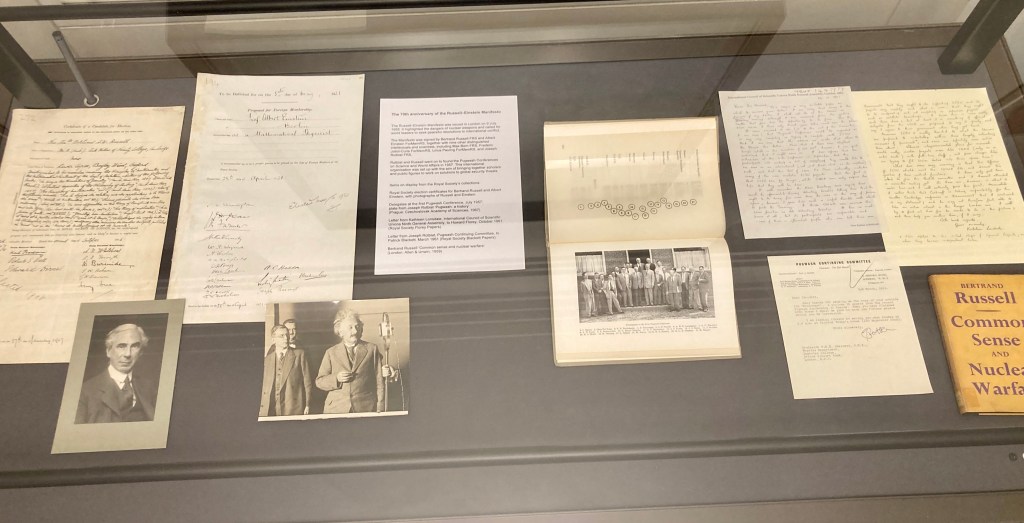
Pugwash expressed its deep appreciation to the Royal Society for generously hosting this event and providing excellent support. We are also indebted to the lead organizer, Peter Jenkins CMG (chairman of British Pugwash), as well as the kind sponsors: The Joseph Rotblat Memorial Trust, the Network for Social Change, The Ambassador Partnership, and the Quincy Institute for Responsible Statecraft.
Programme of the 8 July event

 Pugwash Conferences on Science and World Affairs