There lies before us, if we choose, continual progress in happiness, knowledge, and wisdom. Shall we, instead, choose death, because we cannot forget our quarrels? We appeal, as human beings, to human beings: Remember your humanity, and forget the rest. If you can do so, the way lies open to a new Paradise; if you cannot, there lies before you the risk of universal death.
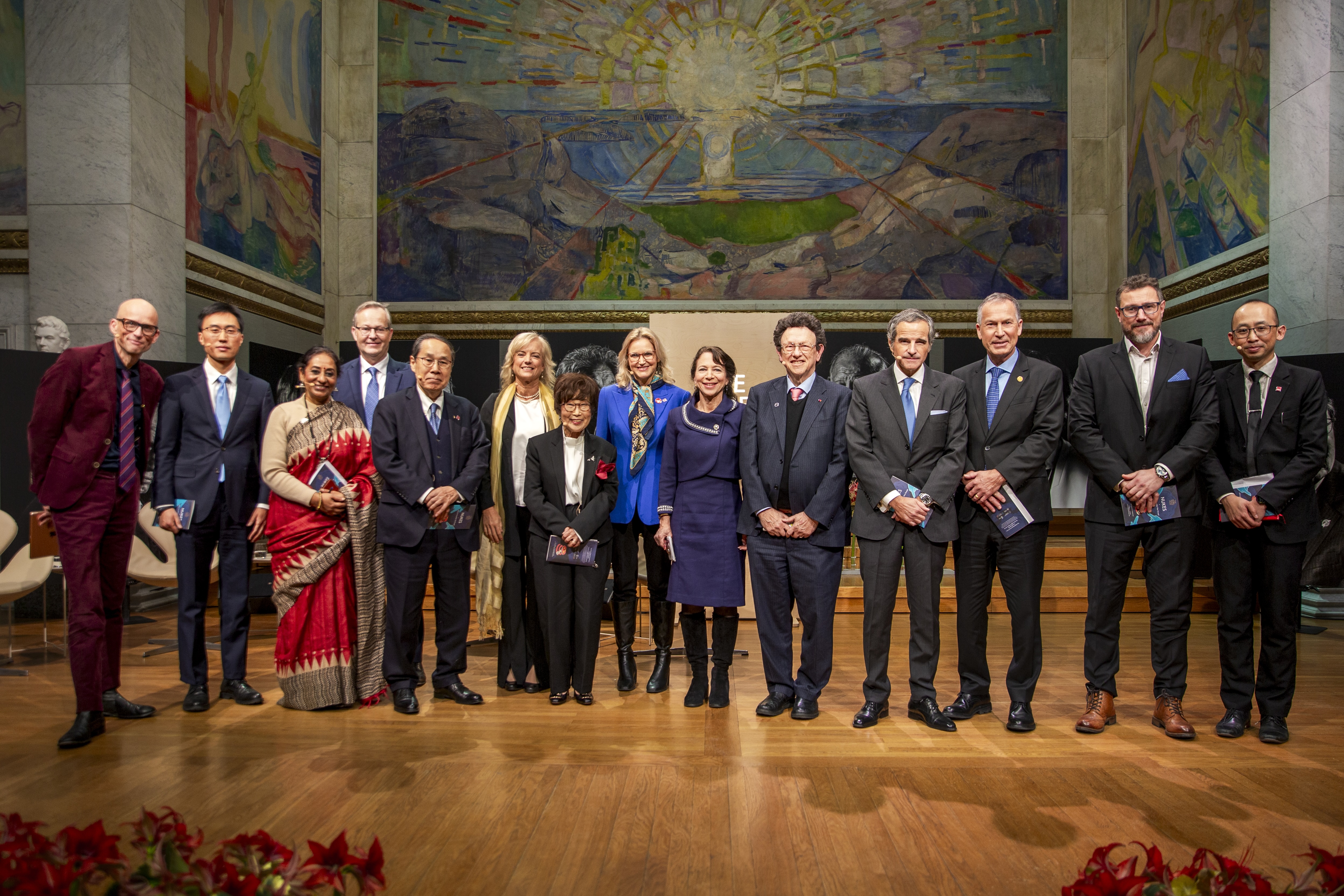
These words from the Russell-Einstein Manifesto were invoked by Jørgen Watne Frydnes, chair of the Nobel Committee, to open the 2024 Nobel Peace Prize ceremony. As a Nobel laureate, Pugwash was honoured to be represented at the award to the Nihon Hidankyo by Secretary General-elect Karen Hallberg. She observed that it was “a moving ceremony and important for the tireless and persistent struggle of the Hibakusha to tell the world about the horrors of the atomic bombs. Although fragile in their age they remain strong in their spirit, saddened by their remembrances but honoured with the Nobel Peace Prize 2024”.
Dr. Hallberg also participated at this year’s Nobel Peace Prize Forum, “NUKES – How to counter the threat” (follow link to watch the video), on a panel session alongside Manpreet Sethi, Wilfred Wan, Hans Kristensen, and chaired by Andrew Futter.
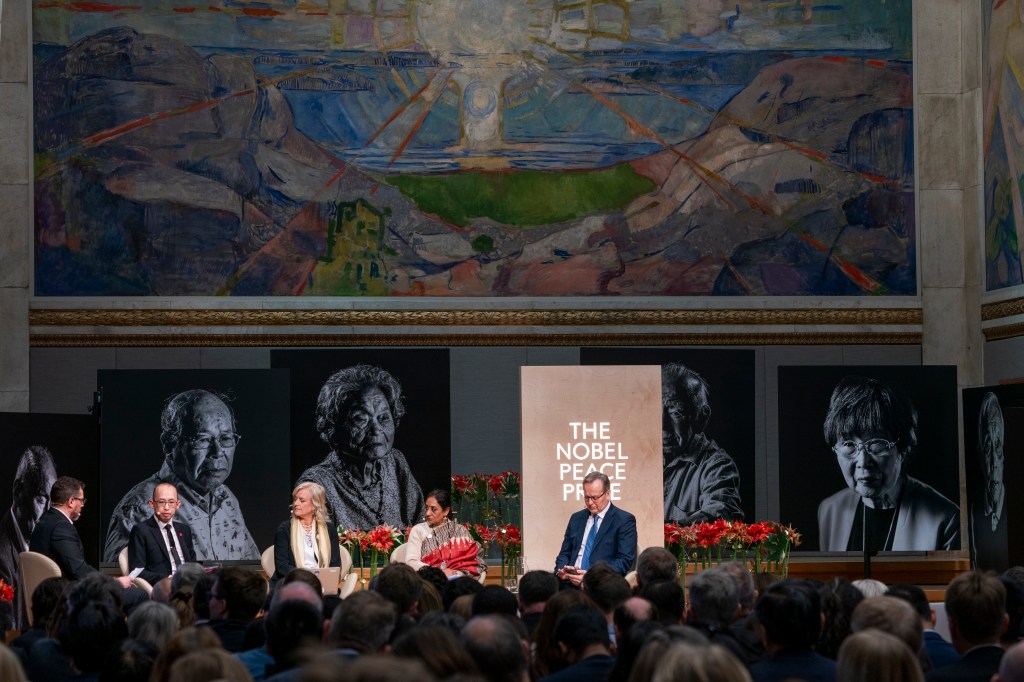
©Photo: Helene Mariussen/Nobel Prize Outreach
Reflecting on the speech given by Mr. Terumi Tanaka of Nihon Hidankyo at the Nobel Peace Prize Ceremony on 10 December, Tatsujiro Suzuki, chair of Pugwash Japan, commented, “it was a very moving speech, with many important policy implications for nuclear disarmament and to realize a world free of nuclear weapons. First, it underlines that the Hibakusha’s experiences are not only those on the bombing days of August 6 and 9, 1945; of course, those experiences were terrible and catastrophic, which proved the inhumane nature of nuclear weapons. But the experiences after the war – continuing up to now 79 years after – are also to be remembered. Discrimination, fear of cancer, severe burns, continuing suffering and pain from illness caused by radiation – the Hibakusha are still suffering. These “after the bomb” experiences are important for those studying the humanitarian consequences of nuclear weapons.
“Second, it emphasizes the responsibility of all nations. Mr. Tanaka repeated the fact that the Japanese government has refused to admit their responsibility and thus never agreed to pay “compensation” to the Hibakusha. The government, unwillingly, agreed to pay, little by little, for medical fees or financial assistance for the Hibakusha. By stressing the responsibility of nations, Mr. Tanaka presses the negative incentive to use nuclear weapons and engage in war.
“Third, of critical importance is the mantra, “No more Hibakusha, No more War”. Upholding this nuclear taboo is the minimum but should never be a broken norm. But Mr. Tanaka emphasize that keeping nuclear taboo means “no existence of nuclear weapons” and NO WAR.
“Let Nagasaki be the Last”- this should be our common goal. Mr. Tanaka’s speech eloquently appealed to the world.”
 Pugwash Conferences on Science and World Affairs